Welcome to “Big Ten offseason at a glance,” a team-by-team look at the conference at the start of the summer. We’ll examine roster movement for each Big Ten roster and give an early outlook for each Big Ten program for the 2026-27 season.
Up next: Nebraska (28-7 overall in 2025-26, 15-5 in Big Ten play)
Previously: Penn State, Rutgers, Minnesota, Northwestern, Washington, Wisconsin, Iowa, Maryland, Oregon, Purdue, USC, Indiana, UCLA, Ohio State
Nebraska put together its best season in program history last winter.
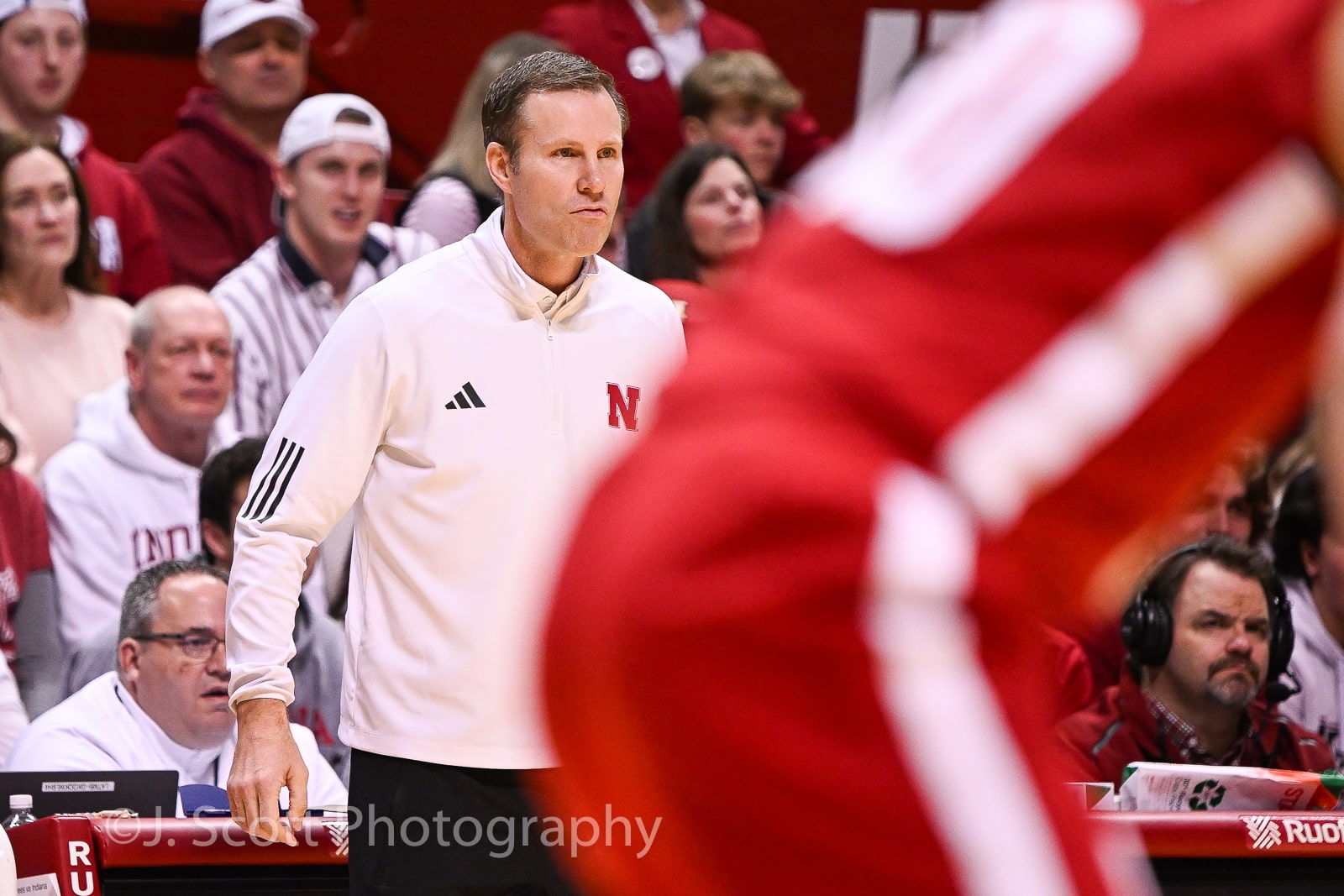
Fred Hoiberg’s team finished 28-7 overall, went 15-5 in Big Ten play and reached the Sweet 16. The Cornhuskers also won the program’s first NCAA tournament game, beating Troy before knocking off Vanderbilt and falling to Iowa in the Sweet 16.
Now, Nebraska enters next season with real expectations.
According to Bart Torvik’s 2026-27 projections, Nebraska is No. 15 nationally, making the Cornhuskers one of the highest-rated teams in the Big Ten entering the offseason. That speaks to what Hoiberg has built in Lincoln, but it also raises the standard after a historic year.
Nebraska roster movement
Players returning with eligibility: Braden Frager, Pryce Sandfort, Connor Essegian, Cale Jacobsen, Leo Curtis, Will Cooper
Players departing due to exhausted eligibility: Jamarques Lawrence, Kendall Blue, Jared Garcia, Sam Hoiberg, Rienk Mast
Players who departed via transfer portal: Berke Buyuktuncel (to Vanderbilt), Quentin Rhymes (to Fresno State), Ugnius Jarusevicius (to Arizona)
Players arriving via transfer portal: Sam Orme (from Belmont), Trevan Leonhardt (from Utah Valley), Kadyn Betts (from Montana), Boden Kapke (from Boston College), Taj DeGourville (from San Diego State), Damon Wilkinson (from South Dakota State)
Players arriving from high school/overseas: Colin Rice, Jacob Lanier
Nebraska lost a lot from last season’s team, but this is not a full rebuild.
The biggest loss is Rienk Mast, who was one of the most important pieces on last year’s roster. He gave Nebraska size and a go-to scorer in the frontcourt. Lawrence and Hoiberg were also key backcourt pieces and Buyuktuncel’s transfer to Vanderbilt removes another frontcourt starter from the equation.
Still, Nebraska retained enough production and added enough portal talent to remain near the top of the Big Ten conversation.
What to like about Nebraska
The biggest reason for optimism is the return of Pryce Sandfort.
Sandfort was Nebraska’s leading scorer last season, averaging 18.1 points, 4.9 rebounds and two assists while shooting 41.6 percent from beyond the 3-point line. He gives the Cornhuskers one of the best returning perimeter scorers in the conference and will enter the season as one of the Big Ten’s top players.
Braden Frager is another major returner. He averaged 11.8 points and 3.8 rebounds while shooting 35.2 percent from 3-point range last season. With Mast gone, Frager’s role should only grow. He gives Nebraska a proven frontcourt piece who already knows the system and can stretch the floor.
The portal class also gives Nebraska plenty to like.
Orme was an All-MVC performer at Belmont and averaged 12.7 points and five rebounds while shooting 39.7 percent on 3s. He fits what Nebraska wants offensively as a skilled, floor-spacing forward.
Leonhardt might be the most important addition because of what Nebraska lost with its guards. At Utah Valley, he averaged 11.9 points, 5.4 rebounds, six assists and 2.1 steals. He gives the Cornhuskers a true playmaker and should help replace some of the creation Nebraska lost with Lawrence and Hoiberg graduating.
Wilkinson also brings needed size after averaging 13.9 points and 6.4 rebounds at South Dakota State. Along with Kapke, Betts and DeGourville, Nebraska has more than enough options to rebuild its frontcourt depth.
What to question with Nebraska
The main question is how smoothly Nebraska can replace its offensive connectors.
Last season, Hoiberg, Lawrence and Mast were the team’s top three assist leaders. All three are gone. That is not easy to replace, especially for a team that thrived because of spacing, ball movement and experience.
Leonhardt should help, but asking a transfer guard to immediately run a high-major offense is never automatic. Nebraska also needs Orme, Wilkinson, Kapke and Betts to translate their production to the Big Ten.
There is also the matter of replacing Mast’s versatility. Nebraska can find more size and rebounding from its newcomers, but Mast’s passing and feel make him difficult to duplicate. The Cornhuskers may have more frontcourt bodies, but they do not have another proven player with Mast’s exact skill set.
Essegian is also a wild card. He played in just seven games last season before suffering a season-ending ankle injury. If healthy, he gives Nebraska another experienced shooter and scorer. If not, Nebraska’s guard depth becomes more of a concern.
Nebraska’s outlook for the 2026-27 season
Here’s the Nebraska Big Ten schedule for next season:
Home: Indiana, Michigan, Minnesota, Ohio State, Rutgers, UCLA, USC
Away: Illinois, Maryland, Northwestern, Oregon, Purdue, Washington, Wisconsin
Home/Away: Iowa, Michigan State, Penn State
For Nebraska, the challenge is no longer proving it belongs, but showing it can sustain last season’s breakthrough with a reshaped roster and higher expectations.