Welcome to “Big Ten offseason at a glance,” a team-by-team look at the conference at the start of the summer. We’ll examine roster movement for each Big Ten roster and give an early outlook for each Big Ten program for the 2026-27 season.
Up next: Indiana (18-14 overall in 2025-26, 9-11 in Big Ten play)
Previously: Penn State, Rutgers, Minnesota, Northwestern, Washington, Wisconsin, Iowa, Maryland, Oregon, Purdue, USC
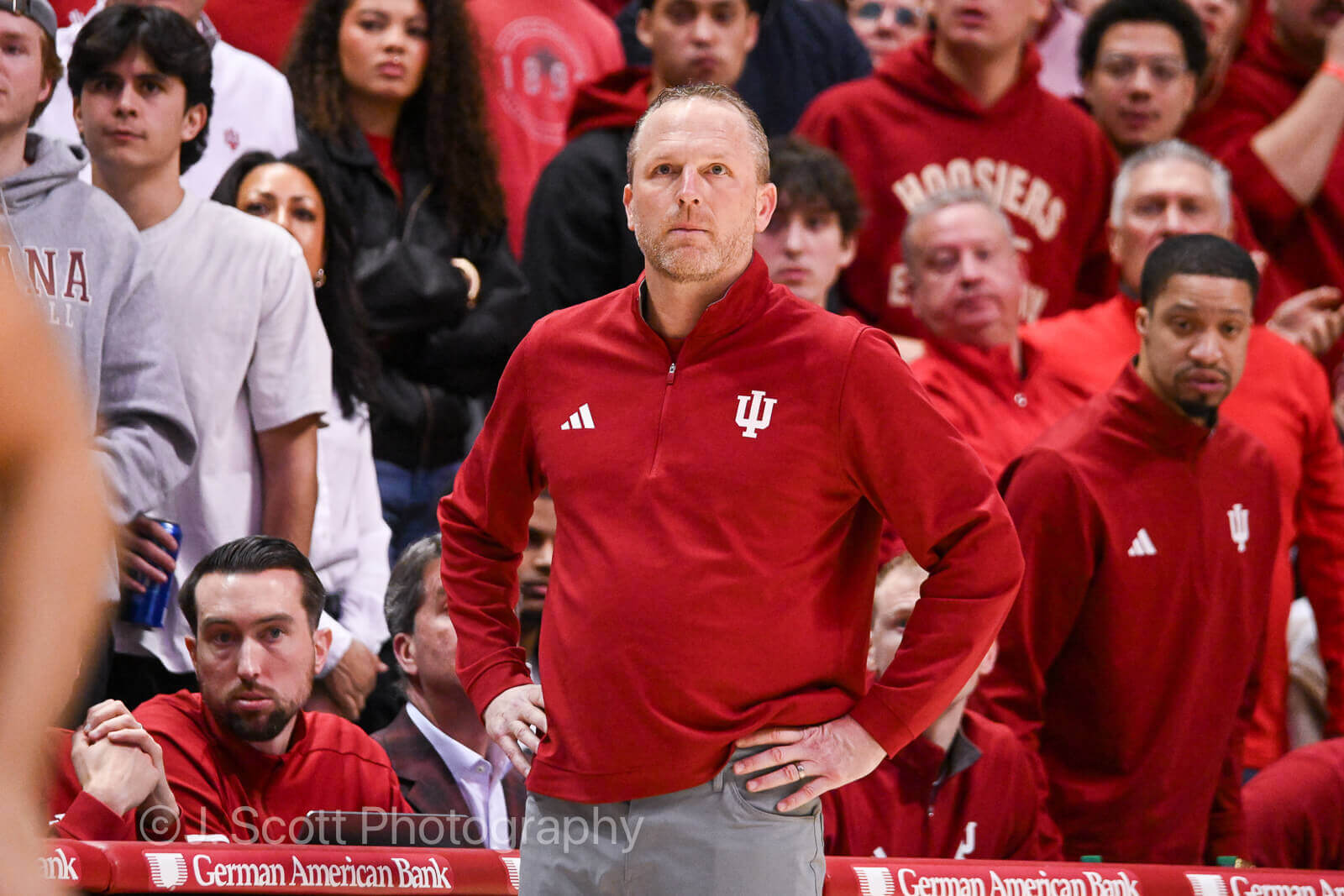
Indiana’s first season under Darian DeVries ended with the Hoosiers in the NCAA tournament conversation, but not in the field.
The Hoosiers opened the season with seven straight wins, but the rest of the year was defined by inconsistency. Indiana followed a 1-3 stretch that included losses to Minnesota, Louisville and Kentucky with four straight wins, then lost four straight Big Ten games. Late in the season, the Hoosiers won five of six games before dropping six of seven to close the season, including two losses to Northwestern in that span.
IU’s stay in the Big Ten tournament was brief, as a loss to the Wildcats ended the program’s March Madness hopes.
Now, DeVries enters year two with another new roster. According to Bart Torvik’s 2026-27 projections, Indiana is No. 27 nationally, putting the Hoosiers in the top half of the Big Ten and comfortably in the early NCAA tournament picture.
Given Indiana’s resources, transfer portal haul and the expanded NCAA tournament field, being near the bubble should not be good enough. DeVries should be expected to get Indiana safely back into the NCAA tournament in year two.
Indiana roster movement
Players returning with eligibility: Trent Sisley
Players departing due to exhausted eligibility: Lamar Wilkerson, Tucker DeVries, Conor Enright, Sam Alexis, Tayton Conerway, Reed Bailey
Players who departed via transfer portal: Andrej Acimovic (to Missouri State), Aleksa Ristic (to Belmont), Jasai Miles (to Loyola Marymount), Jason Drake (to Temple), Josh Harris (to FAU), Nick Dorn (to Miami FL)
Players arriving via transfer portal: Bryce Lindsay (from Villanova), Aiden Sherrell (from Alabama), Darren Harris (from Duke), Markus Burton (from Notre Dame), Samet Yigitoglu (from SMU), Jaeden Mustaf (from Georgia Tech), Justin Monden (from Maryland Eastern Shore)
Players arriving from high school/overseas: Prince-Alexander Moody, Vaughn Karvala, Trevor Manhertz, Clemens Sokolov
Indiana rebuilt its roster for the second straight offseason.
Trent Sisley is the lone returning scholarship player. The Southern Indiana native averaged 4.2 points and 2.8 rebounds as a freshman. He fell out of the rotation in the back half of the season, but with so much roster turnover, he should be in line for a more consistent role as a sophomore.
The bigger story is the portal class Indiana added. The Hoosiers brought in a proven high-major point guard in Markus Burton, frontcourt size in Aiden Sherrell and Samet Yigitoglu, shooting in Bryce Lindsay and Darren Harris and another versatile perimeter piece in Jaeden Mustaf.
What to like about Indiana
DeVries clearly identified Indiana’s biggest problems from last season and attacked them directly.
Indiana finished last in the Big Ten in offensive rebounds with 263 and was in the bottom six of the league in rebounds per game. The Hoosiers could win when Lamar Wilkerson got rolling, but they rarely created extra possessions and too often got dominated on the glass.
That is why Sherrell and Yigitoglu matter. Sherrell averaged 11.1 points, 6.2 rebounds and 2.2 blocks last season at Alabama. Yigitoglu, a 7-foot-2 center from SMU, averaged 10.7 points and 7.9 rebounds while shooting 62.8 percent from the field.
Sam Alexis and Reed Bailey both had moments last season, but neither provided enough production for Indiana. Alexis averaged 8.8 points and 4.8 rebounds, while Bailey averaged 8.3 points and just 3.4 rebounds despite starting at center for a large portion of the year.
The backcourt should also be more dynamic. Burton gives Indiana a true point guard who can score, get downhill and create offense late in the shot clock. His presence should make life easier for Indiana’s shooters.
Lindsay averaged 12.3 points last season at Villanova and made 78 3-pointers at a 35.6 percent clip. Harris gives Indiana a 6-foot-5 shooter with upside after playing limited minutes at Duke. Mustaf averaged 10.4 points, 4.3 rebounds and 2.4 assists last season at Georgia Tech while shooting 38.9 percent from 3-point range.
A year ago, Indiana’s perimeter game was heavily dependent on one player, Wilkerson, who made 104 3-pointers. That should not be the case this season.
What to question with Indiana
The biggest question is how quickly this group fits together.
Indiana has only one returning scholarship player. Sisley should be more comfortable as a sophomore, but he is not yet a proven Big Ten contributor. Everyone else is either new to Bloomington or new to college basketball.
The talent is better and the roster construction makes sense, but that does not guarantee immediate chemistry. Burton will have the ball a lot, Lindsay is at his best as a scorer, Harris is stepping into a much larger role than the one he had at Duke and Sherrell and Yigitoglu both need touches.
The other question is whether Indiana can become tougher and more consistent. Last season’s team was streaky in almost every way. Home losses to below-average teams cannot continue to be a concern. Losing repeatedly to teams like Northwestern, especially in an era where Indiana has the resources to build through the transfer portal, should be over.
Indiana’s outlook for the 2026-27 season
Here’s the Indiana Big Ten schedule for next season:
Home: Illinois, Michigan, Michigan State, Ohio State, Rutgers, UCLA, USC
Away: Iowa, Minnesota, Nebraska, Oregon, Penn State, Washington, Wisconsin
Home/Away: Maryland, Northwestern, Purdue
Torvik’s projection of No. 27 nationally feels about right for Indiana.
There is enough talent to be better than last season. The transfer portal class gives Indiana more scoring options, more size and a legitimate Big Ten frontcourt with Sherrell and Yigitoglu. But there is also enough uncertainty to keep Indiana out of the conference-title tier for now.
Still, this should be an NCAA tournament team. With the field expanding to 76 teams, Indiana should not be sweating out Selection Sunday if this roster is as good as it looks on paper.
The Hoosiers fixed the glaring issues from last season: inconsistent frontcourt production, poor offensive rebounding and rim protection, limited playmaking and a perimeter attack too dependent on one elite shooter. If those fixes translate, Indiana should be back in the NCAA tournament and back in the top half of the Big Ten.
For DeVries, that has to be the baseline.