
2026-27 Big Ten offseason at a glance: Maryland Terrapins

- Zach Horwitz
- Jun 10, 2026 8:24 am
Welcome to “Big Ten offseason at a glance,” a team-by-team look at the conference at the start of the summer. We’ll examine roster movement for each Big Ten roster and give an early outlook for each Big Ten program for the 2026-27 season.
Up next: Maryland (12-21 overall in 2025-26, 4-16 in Big Ten play)
Previously: Penn State, Rutgers, Minnesota, Northwestern, Washington, Wisconsin, Iowa
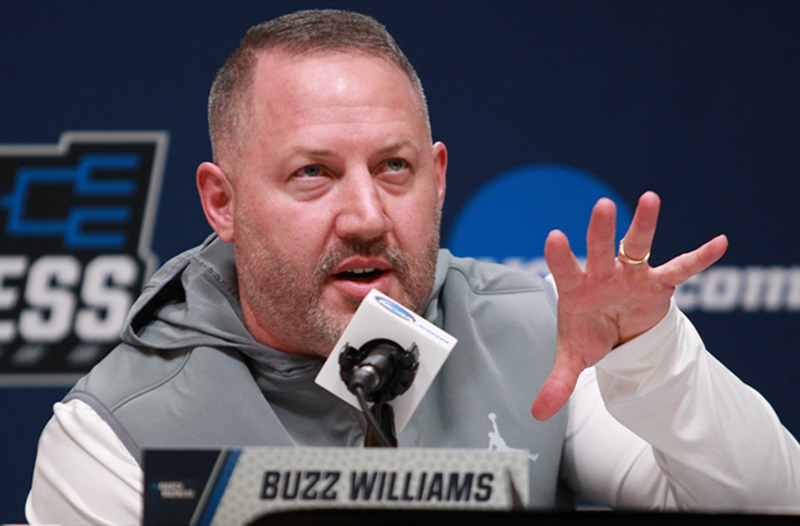
Maryland’s first season under Buzz Williams did not go as planned.
After Kevin Willard left for Villanova following Maryland’s Sweet 16 run in 2025, the Terrapins hired Williams away from Texas A&M to stabilize the program. Williams arrived in College Park with a strong track record, including 11 NCAA tournament appearances and 13 20-win seasons across 18 years as a head coach. He also led Texas A&M to three straight NCAA tournament appearances before taking the Maryland job.
But year one was a major step back.
Maryland finished 12-21 overall and 4-16 in Big Ten play last season, going from a top-tier Big Ten program one year earlier to one of the league’s bottom teams. Now, Williams enters his second season in College Park with a roster that looks much different and a lot to prove.
Maryland roster movement
Players returning with eligibility: Andre Mills, Pharrel Payne, Rakease Passmore, George Turkson Jr., Guillermo Del Pino
Players departing due to exhausted eligibility: David Coit, Solomon Washington, Elijah Saunders, Collin Metcalf
Players who departed via transfer portal: Aleks Alston (to UAB), Darius Adams (to NC State), Isaiah Watts (to UTSA), Jaziah Harper (to North Dakota State), Myles Rice
Players arriving via transfer portal: Tomislav Buljan (from New Mexico), Robert Jennings II (from Oklahoma State), Bishop Boswell (from Tennessee), Maban Jabriel (from Queens), DJ Wagner (from Arkansas), Michael McNair (from Boston University)
Players arriving from high school/overseas: Baba Oladotun, Kaden House, Adama Tambedou, Austin Brown
Like most teams rebuilding in the portal era, Maryland’s roster underwent major changes.
The Terrapins lost several rotation pieces, including David Coit, Solomon Washington, Elijah Saunders and Collin Metcalf. They also saw five players enter the transfer portal, with the most notable departure being Darius Adams, who is heading to NC State.
But unlike some teams near the bottom of the conference, Maryland has a mix of returning production and high-upside portal additions. The headliner is DJ Wagner, a former five-star recruit who spent time at Kentucky and Arkansas before committing to Maryland for the 2026-27 season. Wagner gives the Terrapins a recognizable name and a potential lead guard option in Williams’s second year.
What to like about Maryland
Maryland’s roster has more talent than last year’s record suggests.
The Terrapins return Pharrel Payne, who should be one of the more important frontcourt pieces on the roster. Payne gives Maryland size, strength and a proven Big Ten presence inside. Andre Mills, Rakease Passmore, George Turkson Jr. and Guillermo Del Pino also return with eligibility, giving Williams at least some continuity after a rough first season.
The biggest addition is Wagner. He has not fully lived up to the massive expectations that followed him out of high school, but the talent is still there. In a new situation with a clear opportunity, Maryland will need him to be a steady creator and one of the team’s primary offensive options.
Maryland also added Bishop Boswell from Tennessee, Robert Jennings II from Oklahoma State and Tomislav Buljan from New Mexico. Those additions give the Terrapins more size, depth and high-major experience than some of the other teams projected near the bottom of the Big Ten.
Michael McNair from Boston University and Maban Jabriel from Queens add some mid-major backcourt options, while Baba Oladotun, Kaden House, Adama Tambedou and Austin Brown give the program younger pieces to build around. Oladotun, a five-star recruit, should be a day-one starter and one of the best freshmen in the country.
For a team that finished 4-16 in league play, the roster at least has enough talent to be better.
What to question with Maryland
The main question is whether Maryland has enough proven production to make a real jump.
Wagner is the biggest name on the roster, but Maryland needs him to become more than just a former five-star prospect. He averaged a career-low 7.4 points per game last season at Arkansas, so the Terrapins are betting on a bounce-back season from a player who will likely be asked to handle a major role.
Maryland also has to replace several experienced pieces and figure out how quickly the new roster fits together. Williams has a strong coaching track record, but last season showed that the transition from the Willard era to the Williams era was not going to be seamless.
There is also pressure on Williams to get Maryland back on track quickly. This is not like the surrounding teams in the standings, like Penn State or Northwestern, where merely reaching the NCAA tournament is a historic accomplishment. Maryland has resources, tradition and a fan base that expects to be in the top half of the Big Ten.
After going 12-21 in year one, another season near the bottom of the league would be a major disappointment.
Maryland’s outlook for the 2026-27 season
Here’s the Maryland Big Ten schedule for next season:
Home: Illinois, Minnesota, Nebraska, Northwestern, UCLA, USC, Wisconsin
Away: Iowa, Michigan, Ohio State, Oregon, Penn State, Purdue, Washington
Home/Away: Indiana, Michigan State, Rutgers
Maryland should be better in year two under Williams, but how much better is the real question.
The Terrapins have more intriguing pieces than a typical bottom-tier Big Ten team. Wagner gives them upside in the backcourt, Payne provides a reliable interior presence, Oladotun is a potential star and the portal class has enough experience to raise the floor.
But the Big Ten will not be forgiving. Maryland has road games at Michigan, Ohio State, Oregon, Purdue and Washington and its home-and-away matchups with Indiana, Michigan State and Rutgers will not be easy.
The talent level is improved, but this still feels like a roster with a wide range of outcomes. If Wagner breaks out and the transfers fit quickly, Maryland could climb back toward the middle of the conference. If the offense remains inconsistent and the newcomers take time to adjust, the Terrapins could again find themselves stuck in the bottom quadrant of the league.
Maryland should not be as bad as it was last season, but a return to the NCAA tournament picture still feels like a stretch entering the 2026-27 season.
See More: Commentary, 2026-27 Big Ten preview, Maryland Terrapins