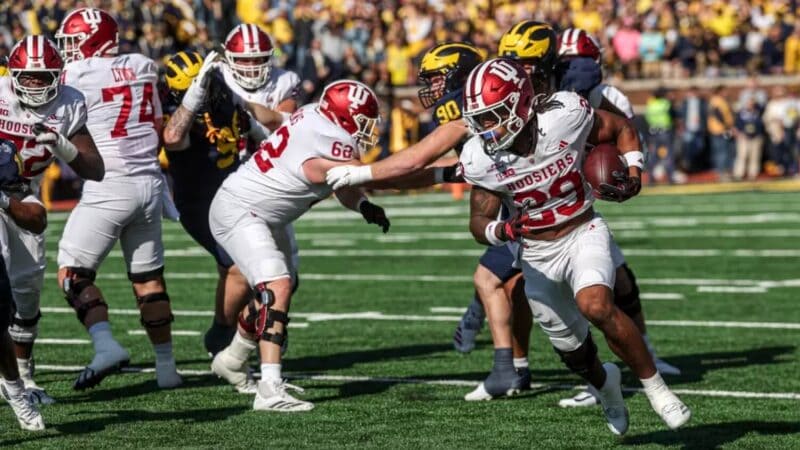
ANN ARBOR, Mich. – Indiana’s offense struggled to find consistency Saturday afternoon, but when the Hoosiers needed one final drive to leave Michigan Stadium with a win, Josh Hoover delivered.
After failing to score a touchdown through regulation, Indiana needed just two overtime plays to take the lead. Hoover connected with Brock Schott on a 21-yard strike up the seam before Schott ran into the end zone from four yards out, giving the Hoosiers a 13-6 win at Michigan.
Indiana, now 7-1, finished with just 212 total yards, failed to complete a pass in the second half and relied heavily on its defense all afternoon. The win marked the program’s first victory in Ann Arbor since 1967 and helped the Hoosiers rebound from last week’s narrow loss to Ohio State.
Here are five takeaways from Indiana’s overtime victory:
Defense delivers in crucial moments
Indiana’s offense struggled for nearly the entire afternoon, but its defense continually made plays when Michigan threatened to score.
The Hoosiers held the Wolverines to 224 total yards, including just 57 rushing yards on 42 attempts and kept Michigan out of the end zone despite several trips deep into Indiana territory.
Perhaps most impressive was Indiana’s ability to generate pressure in critical situations. Three third-down sacks in scoring territory dramatically changed Michigan’s opportunities to put points on the board.
Late in the second quarter, linebacker Rolijah Hardy sacked Michigan quarterback Tommy Carr for a 12-yard loss on third-and-3, forcing the Wolverines to attempt a 53-yard field goal, which they missed.
The defense delivered again on Michigan’s second-half opening possession. After the Wolverines marched downfield and reached Indiana’s 1-yard line, linebacker Tobi Osunsanmi recorded a 13-yard sack on third-and-goal. Michigan then missed a 32-yard field goal.
Hardy made another crucial play in the closing seconds of regulation, sacking Carr on third-and-goal from the 3-yard line and forcing Michigan to settle for a game-tying field goal rather than a potential game-winning touchdown.
Indiana also tackled well in open space, limiting Michigan’s opportunities to turn short completions into explosive plays. The Wolverines converted just six of 20 third-down attempts and averaged three yards per play.
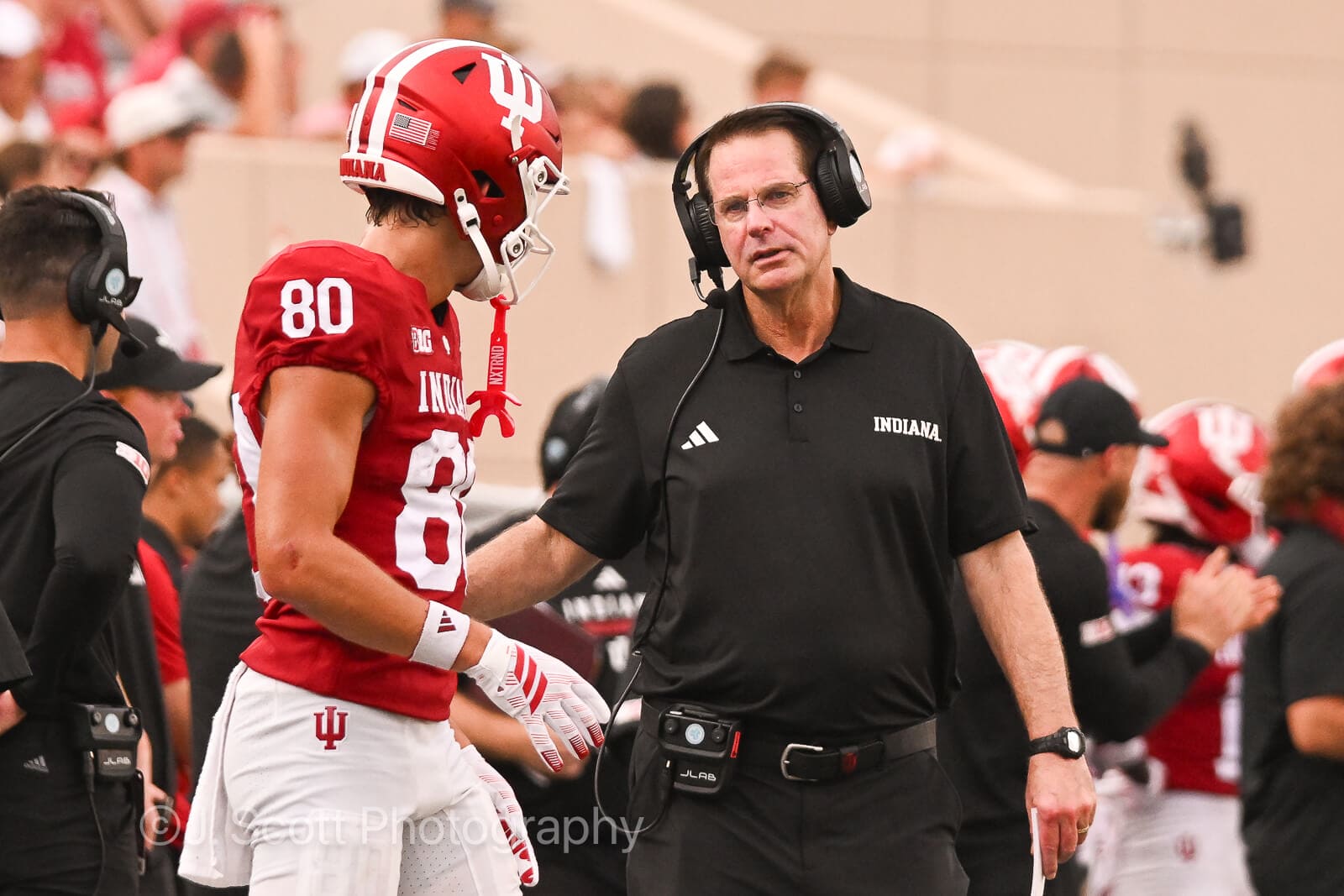
“I just felt like if we didn’t screw it up on offense, once we got the 6-0 lead, that they couldn’t beat us,” head coach Curt Cignetti said afterward.
Indiana’s defense ultimately proved him right, delivering one final overtime stop to secure the win.
Turnover battle makes the difference
In a game with limited offensive production, Indiana’s ability to capitalize on Michigan’s mistakes proved essential.
The Hoosiers forced two first-half turnovers, both resulting in field goals and accounting for all six of their points in regulation.
Indiana’s first takeaway came in the opening quarter when Carr made a poor decision on an option pitch, allowing linebacker Isaiah Jones to recover the loose ball in Michigan territory. The Hoosiers then started the drive near the red zone and Nico Radicic converted a 22-yard field goal.
Early in the second quarter, safety Amare Ferrell intercepted Carr after AJ Harris tipped a pass, returning it to Michigan’s 21-yard line. Although Indiana gained only five yards on its ensuing possession, Radicic connected from 34 yards to extend the lead to 6-0.
Those two possessions demonstrated both the importance of Indiana’s defensive playmaking and the offense’s inability to fully capitalize on advantageous field position.
The Hoosiers eventually committed a costly third-quarter turnover. Hoover threw his first interception of the season, with Michigan defensive back Zeke Berry returning it 37 yards to Indiana’s 13-yard line.
But the defense once again limited the damage, holding Michigan to just two yards on the ensuing possession and forcing a 29-yard field goal.
Indiana ultimately held a 6-3 advantage in points off turnovers. In a game that featured only 12 combined points through regulation, those three points proved significant.
Hoover struggles before delivering in overtime
For much of Saturday’s contest, Hoover looked far from the quarterback who helped Indiana build one of the nation’s most productive offenses through the season’s opening weeks.
The redshirt senior completed just eight of 18 passes for 81 yards and an interception, with seven of those completions coming in the first half.
His struggles were particularly noticeable after halftime. Hoover did not complete a single pass during the third or fourth quarter, leaving Indiana increasingly dependent on its rushing attack and defense.
Cignetti said afterward that Hoover wasn’t fully healthy entering the matchup, though he practiced throughout the week. The coaching staff even discussed potentially turning to backup quarterback Grant Wilson in the second half before ultimately sticking with Hoover.
It proved to be a sound decision.
With Indiana starting possession at Michigan’s 25-yard line, Hoover immediately delivered his biggest completion of the afternoon, finding tight end Brock Schott for 21 yards to set up first-and-goal.
On the following play, Hoover kept the ball himself and rushed four yards for the game’s only touchdown.
“Who would’ve ever thought we’d run Josh down there,” Cignetti said. “The element of surprise is still alive in college football.”
Despite Hoover’s difficult afternoon, Cignetti praised his quarterback for responding when Indiana needed him most.
“When we needed him in that overtime, he was big time,” Cignetti said, calling Hoover “money” in the extra period.
Cignetti expressed optimism that Hoover’s physical condition would improve moving forward.
While Indiana escaped with the victory, the quarterback’s health and the passing game’s recent inconsistency remain important questions as the Hoosiers enter the final stretch of their regular-season schedule.
Special teams loom large in low-scoring contest
A week after missed field goals contributed to Indiana’s four-point loss against Ohio State, the kicking game once again played a significant role Saturday.
This time, however, Indiana benefited from better execution.
Radicic converted both field-goal attempts, connecting from 22 and 34 yards in the first half. He also made the extra point following Hoover’s overtime touchdown.
Those successful attempts mattered, given Indiana’s offensive struggles. Michigan experienced far more difficulty in the kicking game.
Wolverines kicker Trey Butkowski missed a 53-yard attempt late in the second quarter and a 32-yard attempt in the third. The latter was especially costly, coming after Michigan had reached Indiana’s 1-yard line before Osunsanmi’s third-down sack.
Butkowski eventually converted a 29-yard attempt following Hoover’s interception and a 26-yarder as regulation expired to force overtime.
Indiana wasn’t flawless, either. The Hoosiers also had a chance to add to their lead before halftime, but long-range kicker Paddy McAteer missed a 56-yard field goal attempt in the closing seconds of the second quarter.
Still, Radicic’s performance was an important response after he missed both field goal attempts against Ohio State the previous week.
In a game where neither offense reached the end zone until overtime, every successful kick mattered.
Rushing attack shows signs of improvement
After two consecutive difficult performances on the ground, Indiana made noticeable progress establishing its rushing attack against Michigan.
The Hoosiers finished with 131 rushing yards on 35 carries, nearly matching their combined output from the previous two games against Nebraska and Ohio State.
Indiana managed just 65 yards on the ground against Nebraska before rushing for 73 yards against Ohio State. Those struggles largely eliminated the explosive rushing plays that had been central to the offense’s early-season success.
Against Michigan, Indiana began creating more opportunities.
Turbo Richard led the Hoosiers with 68 yards on 19 carries, while Lee Beebe Jr. added 56 yards on 12 attempts.
Perhaps the most encouraging development was Indiana’s ability to break off multiple double-digit yardage runs. Richard recorded a 12-yard gain, while Beebe broke free for 17 yards, giving the Hoosiers plays that were largely absent against Ohio State.
Last week, neither running back managed a carry longer than seven yards as Indiana struggled to create space against the Buckeyes’ defensive front.
Saturday’s performance was hardly dominant, with Indiana averaging just 3.7 yards per rushing attempt, but the ground game became increasingly important as Hoover struggled to move the offense through the air.
With the passing attack producing almost nothing after halftime, Richard and Beebe had to sustain drives and keep Indiana competitive in the field-position battle.
The Hoosiers still have work to do offensively, particularly after managing just 212 total yards and four third-down conversions.
However, Saturday provided at least some encouraging signs that the rushing attack can regain its effectiveness against quality Big Ten defenses.
Indiana didn’t deliver the offensive response it hoped for after the Ohio State loss, but it found another way to win.
And after surviving one of its most difficult offensive performances of the season, the Hoosiers return to Bloomington with their postseason ambitions intact.