IU basketball showed defensive promise in its three exhibition games this fall, holding each opponent to under a point per possession.
The Hoosiers held Butler to 0.88 points per possession, UNC to 0.78 and Western Kentucky to 0.96 in a trio of exhibition games last month.
But through its first three regular-season games, Indiana hasn’t been up to par defensively, despite a 3-0 start that includes a neutral-court win over ACC opponent Syracuse.
After holding Eastern Illinois to 0.81 points per possession – a performance that wasn’t particularly impressive given the Panthers shot 61.1 percent on 2s – IU has given up more than a point per possession in two straight games.
Here are four early-season thoughts on IU’s defensive performance:
Indiana’s rim protection is lacking
The additions of Aiden Sherrell and Samet Yigitoglu, coupled with the unexpected return of Sam Alexis, give the IU coaching staff a frontline with the size necessary to compete in the Big Ten.
Through three games, Indiana’s rim protection has been lacking.
As of Wednesday morning, IU’s block percentage ranks 257th in the country and its 2-point field-goal percentage defense ranks 270th.
Thus far, IU’s opponents are shooting 73 percent at the rim.
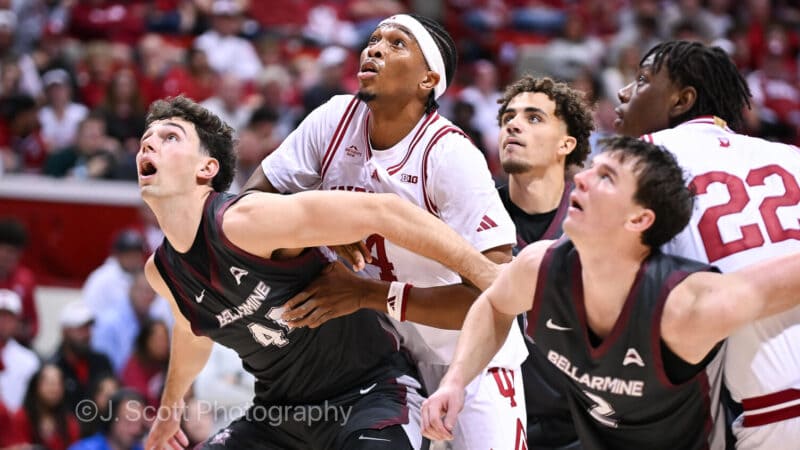
After allowing Eastern Illinois to shoot 61.1 percent on 2s in the opener, Bellarmine shot 55.9 percent on 2s last Thursday and Syracuse shot 55.6 percent on 2s on Monday.
Last season, the Division I average for 2-point field goal percentage was 51.7. Three games into the season, IU’s opponents are making 57.5 percent of their 2s.
Defensive rebounding has been an early-season strength
The Hoosiers have done a good job on the defensive glass, dating back to the first exhibition game.
Including the three exhibition games, Indiana has yet to allow an opponent to grab more than 25 percent of their missed shots.
So far, this is a significant improvement over the 2025-26 season, when Indiana ranked 123rd nationally in defensive rebounding percentage.
The Hoosiers currently rank 31st nationally in defensive rebounding percentage.
Strong work on the defensive glass, coupled with IU’s focus on offensive rebounding, has led the Hoosiers to win the second-chance points battle in every game they’ve played so far, including the exhibitions.
Indiana is doing a poor job of staying in front of the ball, and its ball screen coverage needs work
In his Wednesday media availability, Darian DeVries acknowledged that his team’s defense needs work.
Some of the issues start at the point of attack, where DeVries said his team needs to be better with its “physicality on the ball and staying in front of the ball.”
In addition, DeVries said IU’s ball screen coverage “just hasn’t been what we need it to be right now.”
“Some of that’s just the connectivity as an entire defense,” he said. “It’s not always just the guy on the ball, but the drop coverage, some of the switching, those types of things. And then our backside just getting a little spread out at times.”
Late in Monday’s win against Syracuse, the Hoosiers struggled to contain freshman guard Ryan Moesch, who repeatedly made plays off the dribble out of ball screens.
“In the second half of this Syracuse game, I thought our ball screen coverage wasn’t nearly what we needed it to be and wanted it to be,” DeVries said.
Indiana is forcing turnovers but needs to be smarter about taking chances
DeVries was also asked for his thoughts on his team’s ability to force turnovers in the season’s first three games.
According to KenPom.com, IU’s opponent turnover percentage is 22.1, above average nationally.
Some of that, however, is because the Hoosiers have, at times, been overaggressive in trying to force turnovers rather than staying solid defensively.
When those attempts don’t work out, the defense can often scramble to recover, resulting in easy baskets.
“We’re getting some, and that’s a good thing,” DeVries explained. “We’ve been a little bit all or nothing on some of that. We’re getting some steals and deflections here and there.
“But we’re also giving up some straight-line drives at times. So it’s finding that balance of, like, hey, here’s where we can be aggressive and be able to create those turnovers and advantages.”