INDIANAPOLIS – IU men’s basketball head coach Darian DeVries made rebounding a priority as he rebuilt his roster this offseason. Through two exhibition games, the results have been difficult to ignore.
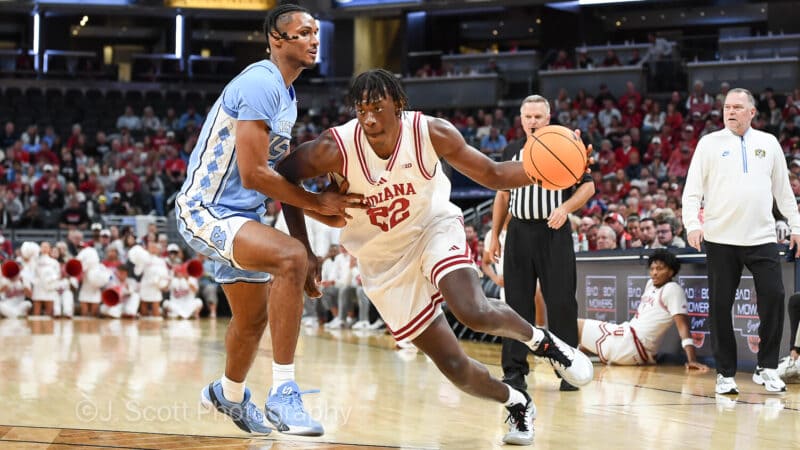
The Hoosiers dominated North Carolina on the glass Sunday evening at Gainbridge Fieldhouse, outrebounding the Tar Heels 53-31 in a comfortable 76-58 victory. Indiana grabbed 20 offensive rebounds, using its physicality and size to create second-chance opportunities even when its offense struggled to stay consistent.
The Hoosiers rebounded 49 percent of their missed shots against UNC.
For DeVries, the performance was another indication that the team’s offseason emphasis is translating onto the court.
“This is our identity. This is who we’re going to be,” DeVries said following the win. “And, you know, just embrace it because we’re going to stay on it, stay on it, stay on it.”
Indiana’s rebounding dominance continued from its first exhibition. In last Sunday’s 96-68 victory at Butler, the Hoosiers held a 53-33 advantage on the boards, including 17 offensive rebounds.
Across the two contests, Indiana has collected 106 rebounds compared to its opponents’ 64, with 37 coming on the offensive glass. The Hoosiers have also outscored their opponents 42-12 in second-chance points, showing they can create offense without relying solely on initial shot attempts.
Much of that improvement comes from Indiana’s revamped frontcourt, led by 7-foot-2 center Samet Yigitoglu and 7-foot forward Aiden Sherrell. Both arrived via the transfer portal, giving DeVries the size and physicality his team lacked a year ago.
Sherrell recorded nine rebounds, including four offensive boards, against Butler, and 10 rebounds with three of those on the offensive glass against the Tar Heels. Yigitoglu added 11 rebounds and six offensive boards to his tally against the ACC foe. The duo helped establish Indiana’s presence inside, with returning forward Sam Alexis providing additional physicality off the bench.
The early contrast from last season has been significant. Indiana finished the 2025-26 campaign with an offensive rebounding rate around 23 percent. Against Butler and North Carolina, that figure has climbed to 44 percent, an early indication of how differently the Hoosiers intend to approach missed shots.
“We built the roster around it. We prioritize it,” DeVries said earlier this week. “To see it show up against Butler was really encouraging.”
That approach carried over against North Carolina, a program with considerably more size and athleticism than Indiana’s first exhibition opponent.
The Hoosiers established their advantage early, outrebounding the Tar Heels 27-14 in the first half. Indiana collected 11 offensive rebounds before halftime, nearly matching North Carolina’s entire rebounding total, while holding a 10-0 advantage in second-chance points.
Those extra possessions proved valuable on an otherwise inconsistent shooting night. Indiana shot approximately 36 percent from the field and committed 15 turnovers, but its activity around the rim helped compensate for missed shots and stagnant offensive possessions.
“I thought the offensive rebounding was great,” DeVries said. “I’d like to make a few more of the first shots, you know, to go with it.”
One possession in particular demonstrated the importance of Indiana’s activity on the glass. With North Carolina hanging around in the second half, Alexis converted a tip-in before an Indiana steal led to a transition 3-pointer from Bryce Lindsay.
DeVries pointed to that sequence as an example of how offensive rebounding can change a game’s momentum without requiring a particularly effective initial possession.
“I thought that eventually broke the game open and gave us some of those cushions,” DeVries said.
The emphasis extends beyond Indiana’s frontcourt. Guards and wings have contributed to the rebounding effort, most notably Jaedan Mustaf and Trevor Manhertz playing big, combining for eight rebounds.
DeVries said that collective approach has been particularly encouraging, with players embracing their individual responsibilities rather than treating rebounding solely as a job for the team’s big men.
After struggling to consistently control the paint last season, Indiana now has multiple options capable of protecting the rim, securing rebounds and keeping possessions alive.
The Hoosiers still have areas to address, particularly turnovers and offensive execution, but after two exhibition games, they’ve established one unmistakable strength.
It’s plenty early, but with 106 rebounds and two convincing victories to show for it, DeVries’ offseason emphasis on physicality is already becoming a defining characteristic of his new-look team.