
Inconsistency hangs over IU basketball as conference play looms

- Nick Rodecap
- Dec 20, 2025 6:22 pm
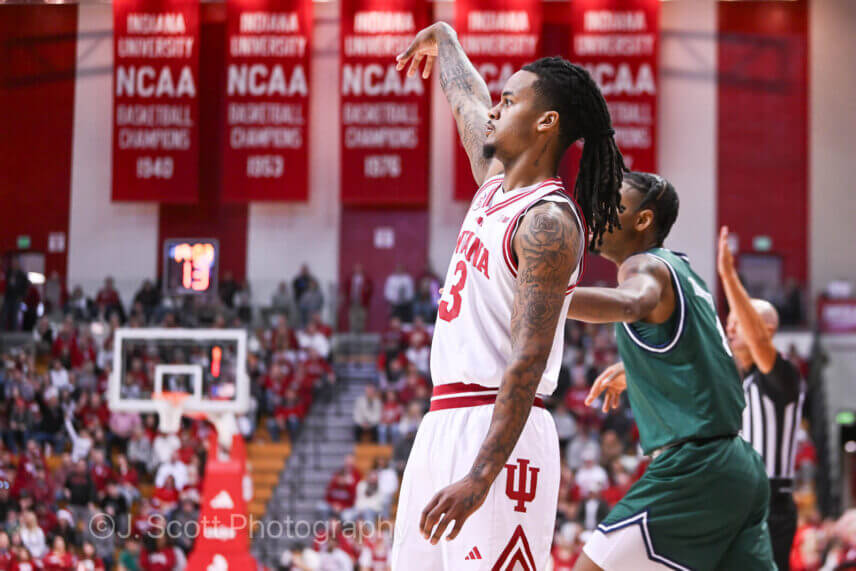
When things go right for Indiana basketball, it looks like a well-oiled machine. The Hoosiers got off to a red-hot start against Chicago State on Saturday, making shots at a 56 percent clip while almost exclusively shooting from 3-point range.
Lamar Wilkerson and Nick Dorn combined for 27 first-half points on 9-of-15 shooting, taking all of their shots from deep and leading Indiana to a 52-29 halftime advantage.
Much like his historic 44-point performance versus Penn State on Dec. 9, Wilkerson looked confident from the jump. He scored nine of Indiana’s first 14 points, helping it take a 10-point lead three minutes into the game.
As a team, Indiana tallied 17 assists on 18 made baskets in the first half. Conor Enright recorded five of his seven assists in the first half while turning the ball over just once. He raised his assist-to-turnover ratio to 4.75, which is fifth in the nation and second in the Big Ten behind Nebraska’s Sam Hoiberg.
Indiana was on pace to eclipse its best 3-point field goal total of the season, which stands at 17. At halftime, the Hoosiers were 14-for-26 from distance. Despite the same ball movement that led to open looks in the first half, they went cold in the final 20 minutes, making just one of their 20 3-point attempts.
Chicago State outscored Indiana 29-26 after halftime, not because it was shooting well – 34 percent from the floor and 20 percent from beyond the arc – but because Indiana did not make a 3-pointer for over 11 minutes coming out of the locker room. The Hoosiers’ 78-58 victory was never in doubt, but their streaky style of play continues to leave doubts about their ceiling in Big Ten play.
Indiana attempted 20 of its 30 second-half shots from 3-point range, continuing to shoot from outside even as its scorers went cold. Darian DeVries said postgame that it is challenging to balance his shooters’ confidence with adjusting the team’s offensive philosophy.
“The easy thing to do is say, ‘Hey, let’s get more paint touches, go drive it,’” DeVries said. “After a while, if we’re not making them, we have to be able to get in there.”
He continued, comparing Indiana’s shooting streaks to when one player kickstarts an offensive flurry on a baseball team. The mojo can go the other way, too.
“Guys feed off one another,” DeVries said. “In that second half, you could definitely feel it go in a negative way for us. We lost a little bit of our confidence. They weren’t shooting it with the same swagger that they’re accustomed to.”
Indiana has experienced hot-and-cold runs on a game-by-game basis – for example, following a 50 percent 3-point shooting night against Milwaukee with a 5-for-24 night against Incarnate Word – but the difference between the first half and the second half against Chicago State was alarming.
“The shots we got in the second half were the same ones (as) in the first half,” DeVries said. “We were getting really good, clean looks by some of our best shooters.”
Against teams that rank higher than 339th in the country in both scoring defense and offense while falling outside the top 300 in rebounding, Indiana cannot afford to lose its perimeter shooting and presence on the glass.
Entering Saturday, Chicago State’s 39.6 field goal percentage ranked 353rd in the nation. Indiana leaned on its defense to secure a 20-point win despite allowing 11 offensive rebounds. It will likely not be able to do the same when Big Ten play resumes on Jan. 4 versus Washington.
“That hasn’t quite registered yet with our group,” DeVries said of the importance of defensive rebounding. “You have to do it a certain way for us to be successful. It’s not going to be a run-and-jump contest for us. It’s got to be a physicality, toughness contest.”
See More: Media, Chicago State Cougars