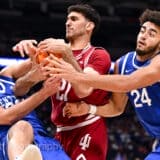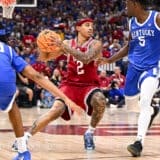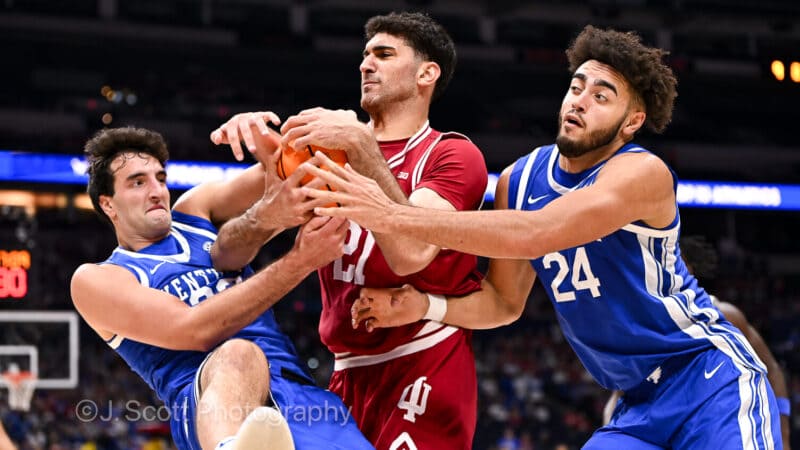
INDIANAPOLIS – Bryce Lindsay’s deep 3-pointer from the right wing bounced off the rim. Jaeden Mustaf reached for the rebound, got a hand on the ball, but couldn’t secure it. Kentucky’s Justin McBride came down with it instead, seemingly ending Indiana’s possession.
But Mustaf wasn’t finished.
As McBride looked to push the ball upcourt, he flipped a short hook pass to his right, targeting Zoom Diallo along the sideline in front of Indiana’s bench. Mustaf read it and darted into the passing lane to intercept it before Diallo could reach it. A whistle for a foul followed.
As the game reached the under-eight-minute media timeout, teammates swarmed Mustaf to celebrate the extra possession he had created. He then stepped to the line, watched his first free throw bounce off the back rim and drop through, and swished the second. Indiana led 76-66 with 7:54 remaining.
It was one of many moments Friday night in which Indiana created opportunities when shots weren’t falling, continuing a promising early-season trend against high-level competition.
Despite Kentucky shooting considerably better from the field, Indiana defeated the Wildcats 90-76 at Lucas Oil Stadium, improving to 6-0 and securing its second statement victory over an SEC opponent in four days.
The Hoosiers shot 39.7 percent to Kentucky’s 54.1 percent, but made 28 of 31 free throws while the Wildcats attempted just seven. Indiana added 14 offensive rebounds, 18 second-chance points, and committed only five turnovers.
“We just wanted to challenge our physicality at halftime to come out and take it from here to there,” Indiana coach Darian DeVries said. “In all phases, offensive, rebounding, driving, and defending.”
That halftime challenge was necessary after an encouraging start nearly unraveled.
Aiden Sherrell knocked down two 3-pointers in the opening two minutes, and Markus Burton repeatedly found ways into the lane.
Indiana built a 36-25 advantage before Kentucky’s Milan Momcilovic took over. He scored 22 first-half points on 8-for-10 shooting, including five 3-pointers, as the Wildcats closed the half on a 12-0 run to lead 47-45.
DeVries said Indiana had grown too comfortable trading baskets while its own shots were falling. When they stopped, the Hoosiers hadn’t done enough defensively to protect their lead.
“I think we fell in love with our shooting a little bit,” DeVries said. “Our message at halftime was, guys, we’ve got to string some stops together.”
Indiana responded by picking up Kentucky’s ball handlers farther from the basket and bringing its big men higher on off-ball screens. The adjustments made the Wildcats work harder to initiate offense and helped contain Momcilovic, who scored just six points after halftime.
On the other end, the Hoosiers kept attacking. Sherrell buried two more 3-pointers, Samet Yigitoglu powered through contact for a dunk and an accompanying free throw, and Lindsay repeatedly pressured Kentucky’s defenders with his ball-handling skills.
Lindsay finished with a team-high 20 points, drawing fouls on drives as well as perimeter shots. Sam Alexis gave Indiana mobility on defense and activity around the rim, while Trevor Manhertz grabbed two important second-half offensive rebounds.
“I thought eventually it just kind of wore into them a little bit,” DeVries said of his team’s ability to rotate fresh players. “We were able to play with a little more energy, a little more physicality just from top to bottom.”
Following Mustaf’s free throws, Burton slithered into the lane for a basket and Alexis finished through contact to stretch the advantage to 80-66. Kentucky never recovered.
Even while shooting just 33.3 percent in the second half, Indiana outscored Kentucky 45-29. Darren Harris finished with 15 points, including nine made free throws, and Burton added 15 points and six assists. Four Hoosiers scored at least 15.
The free-throw disparity wasn’t accidental. DeVries said increasing Indiana’s free-throw rate was an offseason priority after watching opponents consistently get to the line last season. Against Arkansas on Tuesday, the Hoosiers made 30 of 35 free throws. They followed with 28 makes against Kentucky, giving them 58 over two victories.
“Now you’ve got to prove it,” DeVries said of facing Arkansas and Kentucky’s size and athleticism. “You can’t just win on paper and then talk about it.”
Through six games, Indiana has begun doing exactly that.
The Hoosiers aren’t without flaws. Their shooting remains inconsistent, and Kentucky’s late first-half surge exposed defensive lapses that still require attention.
But Indiana has demonstrated it can withstand those stretches without sacrificing its identity.
And with consecutive victories over Arkansas and Kentucky, the Hoosiers are no longer merely talking about becoming a tougher, more physical team.
They’re proving it.