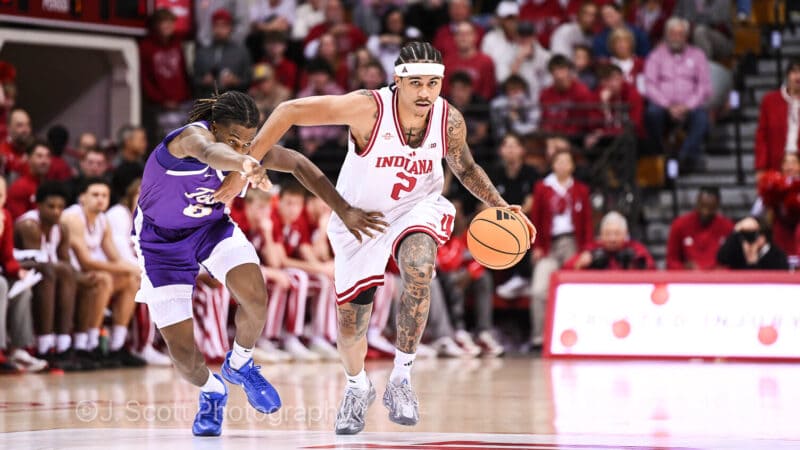
Tennessee Tech arrived at Simon Skjodt Assembly Hall on Thursday night determined to wear Indiana down with 40 minutes of relentless full-court pressure. By the final buzzer, however, the Golden Eagles seemed to run out of answers.
After carrying a narrow four-point advantage into halftime, Indiana overwhelmed Tennessee Tech on both ends of the floor in the second half, outscoring the Golden Eagles 49-29 to secure a 90-66 win and improve to 4-0.
The Hoosiers’ defense was particularly impressive given the opponent. Tennessee Tech entered Thursday averaging 100.7 points per game and attempting 39 3-pointers per contest, the third-most in the country, using a five-out offensive attack to spread out opposing defenses and create opportunities from beyond the arc.
Against Indiana, that offensive production never materialized.
The Golden Eagles finished shooting just 34.3 percent from the field and 9-of-31 from 3-point range. Their struggles worsened after halftime, when they converted only 12 of 38 field-goal attempts and went 3-of-13 from deep.
“Honestly, I have to watch the tape again, but I even thought we were pretty good in the first half,” head coach Darian DeVries said. “I thought we forced a lot of really tough shots.”
Despite Indiana’s early defensive success, Tennessee Tech stayed within striking distance by generating second-chance opportunities. The Golden Eagles outrebounded Indiana 21-18 in the first half, capitalizing on missed shots to extend possessions and prevent the Hoosiers from establishing complete control.
But Indiana’s defensive intensity continued after halftime and its offensive execution finally began to catch up.
Aiden Sherrell credited DeVries’ halftime message for the renewed emphasis on communication and defensive discipline.
“Coach talked to us at the half,” Sherrell said. “He gave us a message like we got to pick it up for sure, and we went out there and executed what he told us to do.”
While Tennessee Tech continued applying pressure across the entire court, Indiana gradually found more opportunities to exploit the aggressive approach.
That aggression also came at a cost for the Golden Eagles. Indiana reached the double bonus with more than eight minutes remaining in the first half, consistently drawing contact against Tennessee Tech’s full-court press and in transition. The Golden Eagles committed 28 fouls, while Indiana capitalized with 26 made free throws on 36 attempts.
DeVries acknowledged that his team had become too structured offensively in the first half, emphasizing post touches instead of letting the offense operate freely. After halftime, increased ball-screen action opened driving lanes and created opportunities for Indiana’s guards, further exploiting a Tennessee Tech defense committed to applying constant pressure.
The adjustments paid immediate dividends. Indiana shot 66.7 percent from the field in the second half, with Bryce Lindsay’s eight second-half points providing a spark and Markus Burton scoring all 12 of his points after halftime.
More importantly, the offensive breakthrough coincided with Indiana’s most effective defensive stretch of the night.
Tennessee Tech struggled to find quality looks against a Hoosier defense that consistently challenged perimeter shots and forced the Golden Eagles to work deep into possessions. Indiana also regained control of the rebounding battle, holding a 23-14 advantage on the glass after halftime.
The combination proved overwhelming. What began as a four-point halftime advantage ballooned into a 28-point lead with just over five minutes remaining, effectively putting the game out of reach.
For DeVries, the performance showed his team’s ability to maintain composure against an opponent whose style demanded constant attention.
“This is one of those games that you don’t sleep as good at night because you’re preparing for 40 minutes of press,” DeVries said. “I knew this was what the game was going to be like, and they were never going to stop.”
Rather than allowing the pressure to dictate the outcome, Indiana absorbed it and gradually imposed its own style of play.
The result was the first real encouraging defensive showing for a Hoosier team still developing its identity under DeVries. And against an opponent that entered Thursday with one of the nation’s most aggressive offensive approaches, Indiana demonstrated that its defensive consistency could be just as decisive as its scoring ability.