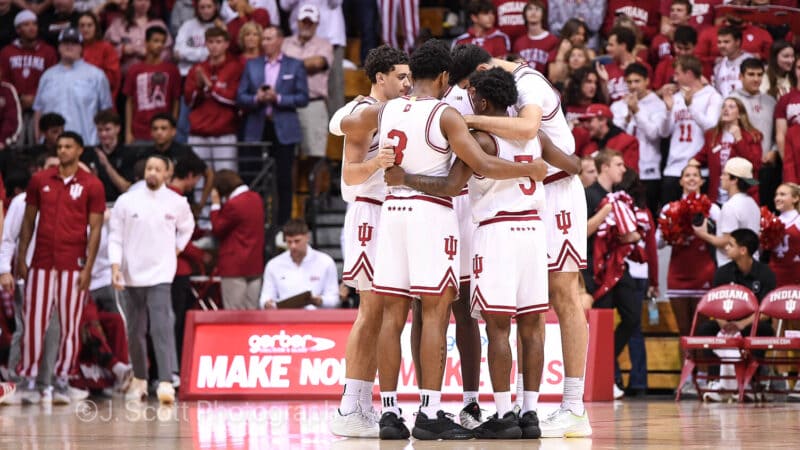
In IU basketball’s first two games, no player has consistently and significantly stood out above his teammates.
There has not been a primary star who has put together two stellar games. There has not been a player who could be called the proverbial “go-to-guy” each time down the floor. Right now, through two games, Indiana does not have a superstar.
That’s a good thing.
Indiana does not have a superstar because, unlike last year, it has a balanced, complete and deep team. Also, unlike last year, it does not need a superstar to succeed.
Last season, Lamar Wilkerson did everything he could to keep the team afloat. Sometimes it was enough; sometimes it wasn’t.
He led the team in scoring in 19 of Indiana’s 32 games, including 18 of its final 23 games. He averaged 20.9 points per game, but lacked help. Tucker DeVries was Indiana’s only other player averaging at least 10 points per game at 13.7. Both Wilkerson and DeVries averaged over 33 minutes per game.
Everyone else on the roster averaged 57.3 points per game combined. The bench unit averaged roughly 24 points per game. Indiana lacked an interior presence, secondary scorers and a deep bench. It proved that having a superstar does not matter if the rest of the team cannot support him.
Maybe a superstar will blossom for Indiana in the 2026-27 season, but that hasn’t happened in two games. What has been on display is the value of a well-built team. Indiana now has the makings of an interior presence, multiple capable scorers and a deep bench.
Yes, it is early and the opponents on the schedule have been obviously and purposely inferior. The trends are certainly worth a look.
Indiana is 2-0 to open the season with a 91-57 win against Eastern Illinois and a 92-69 win against Bellarmine. The Hoosiers have five players averaging at least 10 points and nine players averaging at least six points per game. Darren Harris leads the group at 15.0 points per game. Nobody is averaging over 25 minutes per game.
The leading scorers in each game: Markus Burton and Harris.
Burton scored 19 points in the opener on ultra-efficient shooting. He scored two points on 0-for-7 shooting from the field against Bellarmine. Harris scored seven on 1-for-7 shooting in the opener. He followed it up with 23 on 6-for-11 shooting and went 5-for-10 from 3-point range against Bellarmine.
With this Indiana team, when one player has an off night, the game is not over like it typically was last year.
Indiana is averaging 91.5 points per game and has 86 bench points in two games.
Another issue in the 2025-26 season was the lack of size. Sam Alexis started the final 23 games of the year for the Hoosiers as a 6-foot-9 center. Reed Bailey, 6-foot-10 and 227 pounds, was Indiana’s only other big-man option and struggled in Big Ten play.
Now, Alexis is a flexible bench piece who can play, and has played, both power forward and center. He is behind 7-foot-2, 270-pound center Samet Yigitolu and 7-foot, 250-pound power forward Aiden Sherrell. Indiana also mixes in 6-foot-9 Trevor Manhertz and 6-foot-8 Trent Sisley.
As a result, Indiana has outrebounded opponents 76-52 and 31-13 on the offensive glass, outscoring opponents 36-9 in second-chance points.
Through two games, Indiana is doing everything it did not do last season. It does not need to overwork its top scorers. Rebounding has become a strength rather than a weakness. Lineup versatility has become a possibility. The drop-off from the starters to the bench has been fairly unnoticeable.
This team has an identity based on unselfishness, physicality and using size and depth to its advantage.
Indiana does not have a superstar. It has a team.
Yes, the opponents have been inferior. Yes, it has only been two games. Yes, a superstar could emerge as the season develops.
Regardless, this team is built to succeed in a seismically different way than last year’s team. Given how last season went, that provides for optimism.
The on-court product thus far has supported that idea.