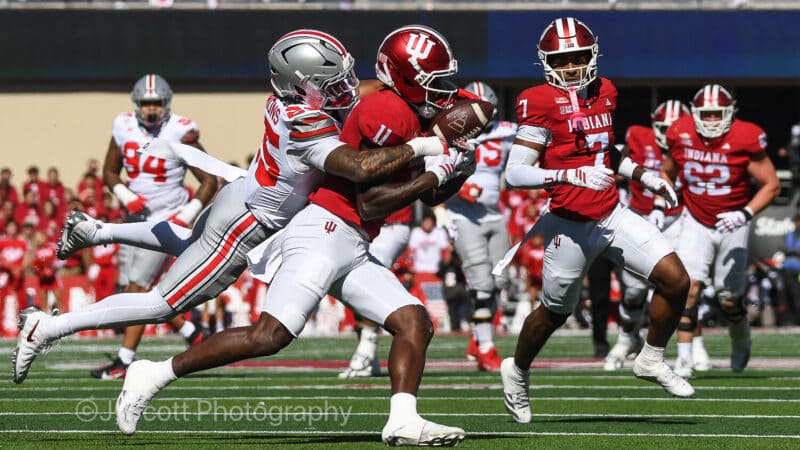
In a game filled with missed opportunities, No. 5 Indiana came within inches of extending its historic winning streak Saturday afternoon at Memorial Stadium, but No. 4 Ohio State escaped with a 19-15 victory.
With just over a minute remaining, IU, led by quarterback Josh Hoover, faced fourth-and-4 from the Ohio State 27-yard line and targeted a wide-open Nick Marsh in the end zone. Marsh had created several yards of separation from his defender, but his left foot landed out of bounds, ending IU’s hopes of a dramatic comeback win.
Despite outgaining the Buckeyes 369-313, forcing two turnovers and turning in a strong defensive performance, the Hoosiers couldn’t overcome their own mistakes. The loss snapped Indiana’s 22-game winning streak and marked Curt Cignetti’s first defeat at Memorial Stadium.
Here are five takeaways from Indiana’s first loss of the season:
Missed opportunities prove costly
Indiana had numerous chances to beat Ohio State despite all of its missed opportunities.
The Hoosiers lost two fumbles on their first two possessions of the third quarter, failed to convert either of their fourth-down attempts and missed both field goal attempts. Kicker Nico Radicic’s 32-yard attempt hit the crossbar with just over five minutes remaining in the first half, a particularly costly miss considering Ohio State followed with an 80-yard touchdown drive to reclaim the lead before halftime.
Even that drive presented Indiana with an opportunity to escape without surrendering a touchdown. The Buckeyes converted a fourth-down attempt near the goal line, turning what could have been a defensive stand into seven points.
Radicic’s other miss came 55 yards out late in the third quarter, with the kick falling short after Cignetti chose to attempt the long field goal rather than go for it on fourth-and-6. Cignetti pointed to the wind as a factor for the miss, saying the kick was “just a little bit out of his range with that wind condition.”
The mistakes extended beyond the offense and special teams. With 7:36 remaining in the fourth quarter, Ohio State faced second-and-28 after Mario Landino’s sack for an 18-yard loss. Backup quarterback Luke Fahey scrambled for eight yards before linebacker Isaiah Jones was penalized for a late hit, giving the Buckeyes an automatic first down at Indiana’s 33-yard line.
Although the defense eventually forced a punt, the unnecessary penalty was another example of Indiana making things more difficult for itself throughout the afternoon.
Even with those mistakes, Indiana had an opportunity to win on its final possession. Hoover’s fourth-down pass found Marsh with significant separation in the end zone, but the receiver couldn’t get a foot down in bounds.
“Had so many opportunities to get it done, not only at the end of the game, but throughout the game,” Cignetti said afterward.
Passing game struggles to capitalize despite late offensive surge
Indiana entered Saturday with one of the nation’s most productive offenses, but moving the ball consistently against Ohio State proved difficult.
Hoover completed just 20 of 40 passes for 296 yards and one touchdown, with 20 incompletions reflecting missed connections and inconsistent execution. Several of his throws sailed high or long over the middle, missing open receivers and preventing Indiana from sustaining drives.
The Hoosiers produced only one sustained touchdown drive, with their first score coming on a two-play, seven-yard possession following an interception by safety Amare Ferrell.
For much of the afternoon, Indiana’s offense struggled to turn promising opportunities into points. Cignetti specifically referenced a second-quarter possession in which multiple receivers were open near the Ohio State end zone, but Indiana failed to capitalize before Radicic’s missed field goal.
“We had a lot of pass game opportunities and we didn’t take advantage of enough of them,” Cignetti said.
The offense finally found momentum in the fourth quarter, marching 75 yards in seven plays before Hoover connected with Marsh for a 19-yard touchdown. A successful two-point conversion cut Ohio State’s lead to 19-15 with 10:30 remaining.
Charlie Becker was a bright spot, finishing with 165 receiving yards and helping keep Indiana’s offense moving through the air. But by the time the passing attack found its rhythm, the Hoosiers were already playing from behind.
Cignetti attributed the earlier struggles to execution, noting that Indiana had opportunities throughout both halves that it failed to capitalize on. The final incompletion to Marsh was the last of several chances the Hoosiers couldn’t finish.
Defense provides blueprint for slowing Ohio State’s offense
While Indiana’s offense struggled, its defense repeatedly gave the Hoosiers opportunities to take control.
Ohio State entered Saturday averaging more than 40 points per game, but Indiana held the Buckeyes to just 19 points and 313 total yards. The Hoosiers limited Ohio State to 78 rushing yards on 37 attempts, recorded four sacks and held the Buckeyes to 6-of-15 on third down.
Indiana’s defense focused on limiting star wide receiver Jeremiah Smith, who entered Saturday averaging more than 150 receiving yards per game. Rather than letting Smith consistently dictate the offense, Indiana forced Ohio State to find production elsewhere.
Smith finished with just 68 receiving yards, although his 38-yard touchdown reception on fourth-and-1 early in the fourth quarter proved decisive. Despite that costly play, the Hoosiers demonstrated how effectively Ohio State’s offense could be disrupted when its most dangerous weapon wasn’t consistently involved.
Ferrell delivered a strong performance, intercepting quarterback Julian Sayin twice. His first interception set up Indiana’s opening touchdown, while his second ended another potential Ohio State scoring drive.
“Yeah, two big interceptions,” Cignetti said. “And that first one led to points. Huge. And the second one was huge, too.”
The return of cornerback AJ Harris to the starting lineup also boosted an Indiana secondary that had dealt with injuries throughout the season. Cignetti noted that Ohio State didn’t target Smith as frequently as usual, using him more as a decoy, particularly early in the game.
Most impressively, Indiana’s defense remained effective despite being repeatedly put in difficult situations, including consecutive turnovers by the Hoosier offense to start the second half. The unit continually gave the offense opportunities to take the lead, only for those chances to go unfinished.
Rushing attack continues to stall against tougher competition
After establishing itself as one of the nation’s most dominant rushing offenses through the opening weeks of the season, Indiana has struggled to maintain that production against stronger Big Ten opponents.
The Hoosiers rushed for just 73 yards on 29 attempts Saturday, averaging 2.5 yards per carry. Turbo Richard led the team with 46 yards, while Indiana managed only one rushing first down throughout the afternoon.
Perhaps the most telling statistic was that Josh Hoover recorded Indiana’s longest rush of the game at just eight yards. Neither Richard nor Lee Beebe Jr. managed a run longer than seven yards, preventing the Hoosiers from generating the explosive plays that defined their early-season success.
Indiana repeatedly attempted to establish the run on early downs, but minimal gains often left Hoover facing passing situations against a talented Ohio State defense. With the quarterback already struggling to consistently connect on throws, the lack of production on the ground only compounded Indiana’s offensive difficulties.
The performance followed a similarly difficult outing against Nebraska, when Indiana rushed for just 65 yards in its narrow 20-17 victory.
In its last two games, Indiana has totaled just 138 rushing yards, a stark contrast to the explosive production it displayed earlier in the season. The week prior, against Rutgers, the Hoosiers had two running backs surpass 100 yards as their balanced offensive attack overwhelmed the Scarlet Knights.
Ohio State’s defensive front deserves credit for limiting Indiana’s rushing lanes, but the offensive line’s inability to consistently establish the run has become a concerning development.
After overwhelming opponents on the ground to begin the season, Indiana has now gone consecutive weeks without finding an answer against more physical defensive fronts.
Historic winning streak ends, but Indiana’s goals remain within reach
For the first time in nearly two years, Indiana will enter a game coming off a loss.
Saturday’s defeat ended the Hoosiers’ 22-game winning streak, which began in 2025 and included last year’s national championship run. It also marked Cignetti’s first home loss since taking over the program, ending a remarkable stretch.
The loss drops Indiana to 6-1 overall and 3-1 in Big Ten play, reducing its margin for error in both the conference championship race and College Football Playoff picture.
However, a four-point defeat against a top-five opponent doesn’t eliminate the Hoosiers from postseason contention, especially with several important games left on their schedule.
Indiana will now turn its attention to Michigan, looking to rebound from consecutive close contests against Nebraska and Ohio State. The challenge will be correcting the mistakes that proved costly Saturday while building on the defensive performance that nearly delivered another signature victory.
Cignetti made clear afterward that despite the disappointment, Indiana’s larger ambitions remain unchanged.
“Sun comes up tomorrow, and get ready for Michigan,” Cignetti said. “Learn from the things we got to learn from. And it’s still all ahead of us. We can accomplish anything we want, all our goals, except going undefeated.”