
Five takeaways from IU’s trip to Peru for the FISU America Games

- Alex Bozich
- Jul 28, 2026 3:53 pm
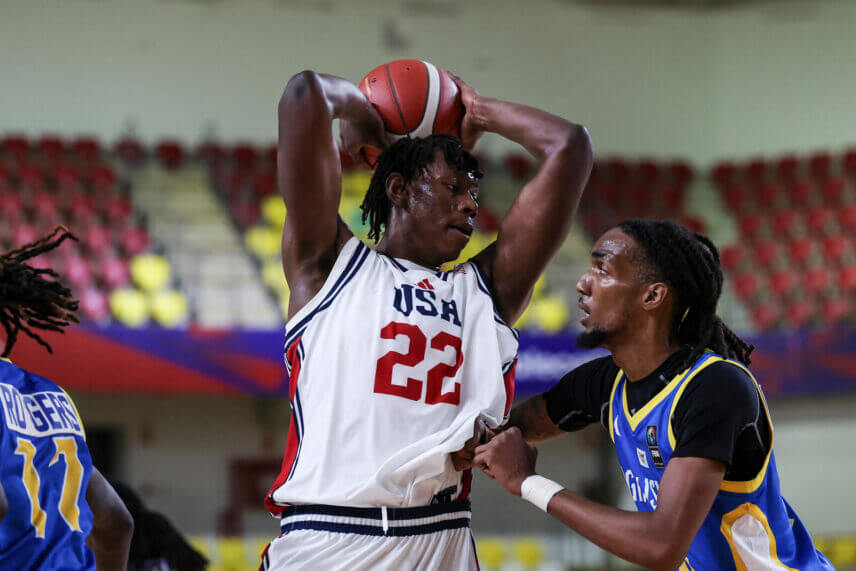
IU basketball concluded its trip to Lima, Peru, with a gold medal in the FISU America Games. The Hoosiers, representing the United States, finished 4-0 in the event with four lopsided wins.
Here are five takeaways from the trip:
Aiden Sherrell was IU’s best player in Peru
Aiden Sherrell, a 2024 McDonald’s All-American who left Alabama after two seasons last spring for the transfer portal, was IU’s best player in its open practices this summer, its exhibition at Assembly Hall and on the trip to Peru.
The 6-foot-11 big man, who is noticeably better shape than he was last season with the Crimson Tide, will start games at the four next season for Darian DeVries.
Sherrell was the program’s most productive player on the trip, despite playing limited minutes due to lopsided scores.
Named the MVP of the FISU America Games, Sherrell averaged 14.5 points, 7.8 rebounds, 1.8 blocked shots, 1.5 assists and 1.3 steals in the event. He shot an efficient 61.5 percent from the field.
Those numbers don’t mean much given the level of competition, but Sherrell should be in line to take a statistical leap next winter.
He’s in better condition than he was during his time in Tuscaloosa and looks capable of handling more minutes. As a sophomore last season, Sherrell averaged 23.9 minutes per game, a number that should grow next season for the Hoosiers.
“I think Aiden looks terrific,” Darian DeVries said Tuesday. “I think you have a big shout-out to our strength and conditioning staff for putting him in a really good spot. You’ve got to give a lot of credit to Aiden, too. He’s really made it a priority. He’s got himself in great shape. He’s running well. I think he feels healthy. That’s a big part of it, too. And you can see it out on the floor.”
IU’s three freshmen continued their development
Projecting freshmen in college basketball has always been a difficult task and it’s become even more difficult as rosters have gotten older in recent seasons.
None of the IU’s three freshmen are expected to start next season, but all three gained valuable experience this summer that should help ease their transition to college next winter.
The Hoosiers want to shift the program’s model from reliance on the transfer portal to one of recruiting, developing and retaining talent.
The trio of Prince-Alexander Moody, Vaughn Karvala and Trevor Manhertz all look capable of developing into productive Big Ten players in the long term.
“All of our freshmen, they’re developing their bodies and things,” DeVries said. “So time will tell in terms of getting on the floor and in Big Ten basketball. But I love what those guys are doing.”
The extra practice time and timing were the primary benefits of the trip
The Hoosiers won all four of their games with ease and were never seriously challenged over 160 minutes of basketball in Peru.
While it would have been positive to get pushed in at least one of the games in the FISU America Games, the extra practice time and the timing were the primary benefits of the trip.
From a practice perspective, the Hoosiers had few restrictions on their prep for the event, which allowed DeVries and the coaching staff plenty of time to install offense and defense ahead of the start of official practice in the fall.
“We have so much stuff in now, when we come back in the fall and your hours get cut back, we can really utilize that a lot more towards our skill work, our individual player development,” DeVries said Tuesday. “So that’s a great luxury to have because we don’t have as much to put in.”
In addition, the timing of the trip now allows the roster an extended break.
Typically, traditional foreign tours in college basketball take place later in the summer, leaving less time for rest and recovery before the start of the fall semester.
“That’s why we really were intrigued by this trip because typically when you take these type of tours or whatever, a lot of times you go into mid-August and then you just get a week and then you start school and then you’re back at it again,” DeVries said. “That’s why this trip we felt like was just going to be a really good chance for us to get all the advantages of a tour, but then also get the break, too. So our guys get to go home here for three weeks and refresh.”
Bryce Lindsay showed his potential as a backup point guard and playmaker
It was a quiet trip to Peru for Markus Burton, who averaged 6.8 points, 2.5 rebounds, 3.5 assists and 1.5 steals while shooting 44 percent from the floor.
It’s unwise to draw any conclusions from late July games, including the less-than-expected production from Burton, but the IU guard who stood out most was Bryce Lindsay.
The Villanova transfer looks like the answer at backup point guard when Burton goes to the bench next season.
Lindsay averaged 4.5 assists in Peru and had six assists in each of the wins against the Virgin Islands.
In addition to his playmaking for others, Lindsay also had 17 points, a team-high, in the final against the Virgin Islands.
Trent Sisley continued to display his offseason improvement
With a full year of experience under his belt, sophomore Trent Sisley played like he better understands his role for next season.
In IU’s wins in Peru, Sisley ran the floor well, was effective on the glass and moved well away from the ball.
He ended the trip with averages of 9.3 points and 5.3 rebounds and shot 17-for-22 from the field. For Sisley to maximize his value offensively, he’ll need to consistently make perimeter shots at a higher percentage than last season (27.1 percent).
Sisley has put in a lot of offseason work on his body better to prepare himself for the rigors of the Big Ten.
Defensively, he still has room to grow, but he is rounding into a rotation piece that DeVries can consistently rely upon next winter.
(Photo credit: IU Athletics)
See More: Five Takeaways, Aiden Sherrell, Bryce Lindsay, FISU America Games, Prince-Alexander Moody, Trent Sisley, Trevor Manhertz, Vaughn Karvala