
Opponent Q&A: Inside the Hall previews Rose Bowl with Touchdown Alabama’s Justin Smith

- Josh Pos
- Dec 27, 2025 11:08 am
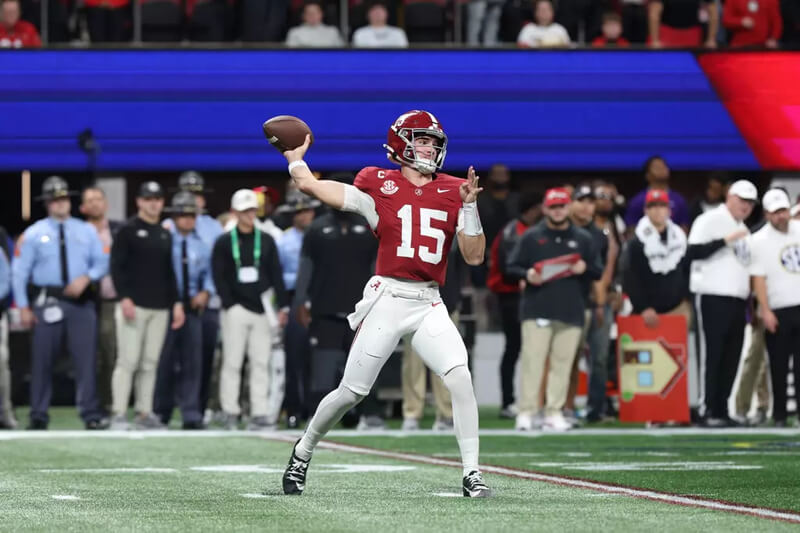
Ahead of next Thursday’s CFP quarterfinal battle between No. 1 Indiana and No. 9 Alabama at the Rose Bowl, Inside the Hall spoke with Touchdown Alabama’s Justin Smith.
Smith is the managing editor and lead writer for Touchdown Alabama and has covered the Crimson Tide for 9 seasons, including two national championships.
Below is the full Q&A previewing the New Year’s Day matinee between the Hoosiers and Crimson Tide.
How important is it that defensive lineman LT Overton is returning?
JS: I think it’s really important, especially from the standpoint of getting essentially a leader of that defensive line group back. Coming into the season, that was one of the reasons why — (Alabama NT) Tim Keenan III is the captain and really the leader of the team — but adding another veteran who has played a lot in the SEC over the last three years, even going back to his time before Alabama in Texas A&M, is huge.
He’s a disruptor in a lot of different ways. He can bring pressure on opposing quarterbacks from multiple spots along the Tide’s defensive line because that’s kind of how the Kane Wommack 4-2-5 swarm defense is designed. It’s gonna be a lot of rotation, a lot of guys going in and out, a lot of guys in different positions, but he’s gonna be one of those guys that can finish, that can get to the quarterback. You don’t really have to stunt as much with him because he can win on his own.
He’s strong against the run as well and he adds depth to a defensive line that seems to be taking the right steps forward.
What would it mean for Alabama’s defensive line to get pressure on Fernando Mendoza?
JS: It’s going to be super important. He can use his feet to make plays. One thing about great quarterbacks in college football now is that they use their legs to extend plays so they can throw the ball downfield.
One of the biggest keys is making him uncomfortable. That’s probably one of the weaker parts of Mendoza’s game — not that he can’t run, but he’s not an explosive runner. He’s good at getting out of the pocket and still throwing the football, but he’s not a dynamic, fast quarterback like [Oklahoma quarterback John Mateer].
That said, he’s still a great quarterback. Alabama’s defensive back end is really talented, but Indiana’s offense is also very confident and very consistent. They don’t have a lot of ups and downs.
So pressure is vital. If they can make Mendoza uncomfortable in any way, it can really benefit Alabama.
What are some strengths and weaknesses of Alabama quarterback Ty Simpson and how could his past performances predict what he’ll look like against Indiana’s defense?
JS: Simpson is a guy in terms of his ability to make plays, contingent on a lot of things in my mind. If he can’t get the pass protection, I feel like he struggled early on against Oklahoma. Oklahoma got home to him quite a bit early early on and it seemed as if he was a deer in headlights in terms of him establishing where the pressure was coming from and communicating on all those different things, whether it was the running backs not picking up the blitzes correctly or the stunts that the Sooners were throwing.
He can make all of the throws on the football field when he has time to, when he’s comfortable, when he’s under control. He has a great feel for the pocket. He’s a great quarterback, but he’s been really inconsistent for a variety of reasons, whether it is dropping the ball or not having the appropriate pass protection.
How vital is it for Alabama to establish the run?
JS: It’s tricky because Simpson has actually been able to throw the football with just an average run game, which is probably more impressive in terms of him being able to pass the football. I think a lot of people have accepted that the run game probably isn’t going to be great this season.
They’ve shown they can win with an average run game. If they can improve it, that’s huge — but it’s definitely a “see it to believe it” situation, because we haven’t really seen Alabama dominate on the ground all season.
What are three keys to the game that you’ll be looking for?
JS: First, pressure on Mendoza — seeing how he responds to it. He can make plays with his feet, but he’s not an explosive runner, so you want to force him to throw under duress.
Second, Ty Simpson getting back to that Heisman-level form for Alabama. If he shows flashes of that version of himself, Alabama can win this game. That’s what we saw against Oklahoma — great throws, receivers catching the ball and the offense clicking.
And third, the trenches. Every game comes down to the trenches. There’s a narrative that Indiana doesn’t have the guys to match up with Alabama, but Indiana has heard that all year and continues to compete. The battle up front could tell the story of this game.
Does this game have a specific narrative?
JS: I think Alabama sees it as a level playing field. Based on the interactions that I’m seeing, there’s a lot of respect for Indiana. They know that Indiana is a really, really good football team. You don’t become the No. 1 team, earn a bye and win the Big Ten without being a great team.
There is a narrative being painted that, hey, Alabama has all of these blue-chip recruits, these four and five-star guys that Indiana does not have. And technically, that may be true in terms of when you look at both of these rosters, but I think probably the narrative that would be pushed in terms of the results of this game is the SEC versus the Big 10 narrative.
I think that narrative is gonna be one. There’s gonna be push, no matter the result.
If Indiana wins, the SEC is no longer the big dog in college football; it is the Big 10. The team that’s supposed to be little Indiana. They beat the powerhouse. If Alabama wins, the pendulum swings and it returns as one of the best teams in college football.
Still, whatever people think it is to be this big-time program, historical, and all those different things that you attach to Alabama football. And you also say, hey, look, the SEC is still a big dog. The Big 10 champion can’t even beat the team that did not even win the SEC championship.
But five years ago, nobody would’ve thought Indiana had a chance against Alabama. Now, Indiana is the favorite, and most people think they can win.
It’s a strange and fascinating moment in college football history. What Indiana has become is real and it looks sustainable. That’s why this game is so intriguing from a historical standpoint.
(Photo credit: Alabama Athletics)
See More: Football