
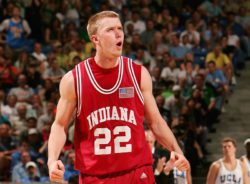
Lance Stemler spent two seasons at Indiana under former coach Kelvin Sampson and made two NCAA tournament appearances. Stemler, who now resides in Sellersburg, spoke at length recently to Inside the Hall about his time in Bloomington, the tumultuous 2007-08 ...
Around the Hall is recommended reading from the Inside the Hall crew. So go ahead, get your read on. + Stephen Curry is hoping for a quick recovery from an ankle sprain, but missed Team USA’s practice on Thursday. Curry, ...
College basketball seasons are long and dynamic things. They’re not like college football seasons, which require drilled excellence from the outset and where a midseason loss can kill your chances at winning a truly screwed-up national championship. They’re not like ...
A season that started with promise and aspirations of a run to San Antonio ended Friday night as Indiana fell to Arkansas 86-72 in the first round of the East Regional in Raleigh, North Carolina. The Hoosiers (25-8) started the ...
Strong out of the gate: In each of IU’s last three losses, they’ve trailed at halftime and in two of the games (Michigan State and Minnesota), they’ve trailed big early. Playing from behind is not advisable for anybody in the ...
Bad decisions. If you can boil down IU’s entire struggle with injured little meek please-govnah-don’t-hurt-us Penn State yesterday, that was it. Bad decisions. Bad decisions from the three-point line. Bad decisions in the post. Bad decisions on defense. Whatever bad ...
It took a while for the Hoosiers to pull away in this one — thanks to Northwestern’s back cuts and three-point shooting — but with around eight minutes to go, Eric Gordon hit a few shots, D.J. White chipped in ...
(Yes, we are aware of the Eric Gordon wrist injury rumors floating around various message boards. We’ll keep you updated if anything official comes to the surface. Now, onward…) Ahh, the four spot. No doubt about it, the lack of ...

There have been plenty of moments of frustration thus far this season. E.J.’s turnovers, seemingly the one thing keeping him from being a truly dominant college basketball player. The lack of a true point guard, leading to skittish play from ...
Talk about a frustrating, sloppy night for the Hoosiers. EJ picked up three fouls in the first half, (the first ticky-tac; the second a charge; the third was a bit suspect, but there was no reason for him to be ...
There’s not a whole lot to say about this one. Tennesssee State, not unlike Chicago State last year, comprised a bunch of skittish guards and guys who put the small in small forward. (Zing!) Undersized and underskilled, they were never ...
First, apologies for the day-lateness. Thanks to an overeager waitress at Duffy’s in Chicago on Saturday night, I never wanted for a fresh Fat Tire, which, as you can imagine, is not the best way to avoid drunkenness if you’re ...
Kelvin Sampson addressed the media Thursday afternoon and here are a few highlights of what he had to say, courtesy of IU Media Relations: On Eric Gordon’s play in comparison to other freshmen he has coached: “I’ve never had a ...
A win is a win, sure, but there was plenty to complain about during IU’s 83-79 win over Georgia Tech last night. So let’s get into it. Hopefully this doesn’t become a recurring theme, because this team is too talented ...
Eric Gordon scored 29 points and D.J. White added 18 points and 14 rebounds as No. 15 Indiana held off Georgia Tech 83-79 in the Big Ten/ACC Challenge on Tuesday night at Assembly Hall. The Hoosiers (5-1) led 38-34 at ...